
Why ESG Is Important: A Malaysian Business Guide For You
🌱 Introduction: ESG Is Everywhere
If you’ve been paying attention to business news, corporate announcements, or even government policies, one word keeps popping up: ESG.
Banks are talking about it. Bursa Malaysia is enforcing it. Big companies are shouting about their ESG initiatives. And maybe you’re wondering — “Why is ESG so important? Why suddenly everyone so kan cheong (so urgent) about this?”
Don’t worry, you’re not alone. Many SME owners, investors, and even employees are asking the same thing. So let’s break it down in simple, Malaysian-style English — no jargon, no boring textbook talk. Just straight-to-the-point answers on why it is important for your business, your money, and even your daily life.
- Why ESG Is Important: A Malaysian Business Guide For You
- 🌱 Introduction: ESG Is Everywhere
- 🤔 First Things First: What Is ESG?
- 📌 Why ESG Is Important — The Big Picture
- 🧭 Why ESG Is Getting Important for Different Stakeholders
- 📊 Malaysian Examples: ESG in Action
- 🛠️ How Malaysian Businesses Can Start With ESG
- 🚀 The Future of ESG in Malaysia
- ✅ Conclusion: Why ESG Is So Important in Malaysia
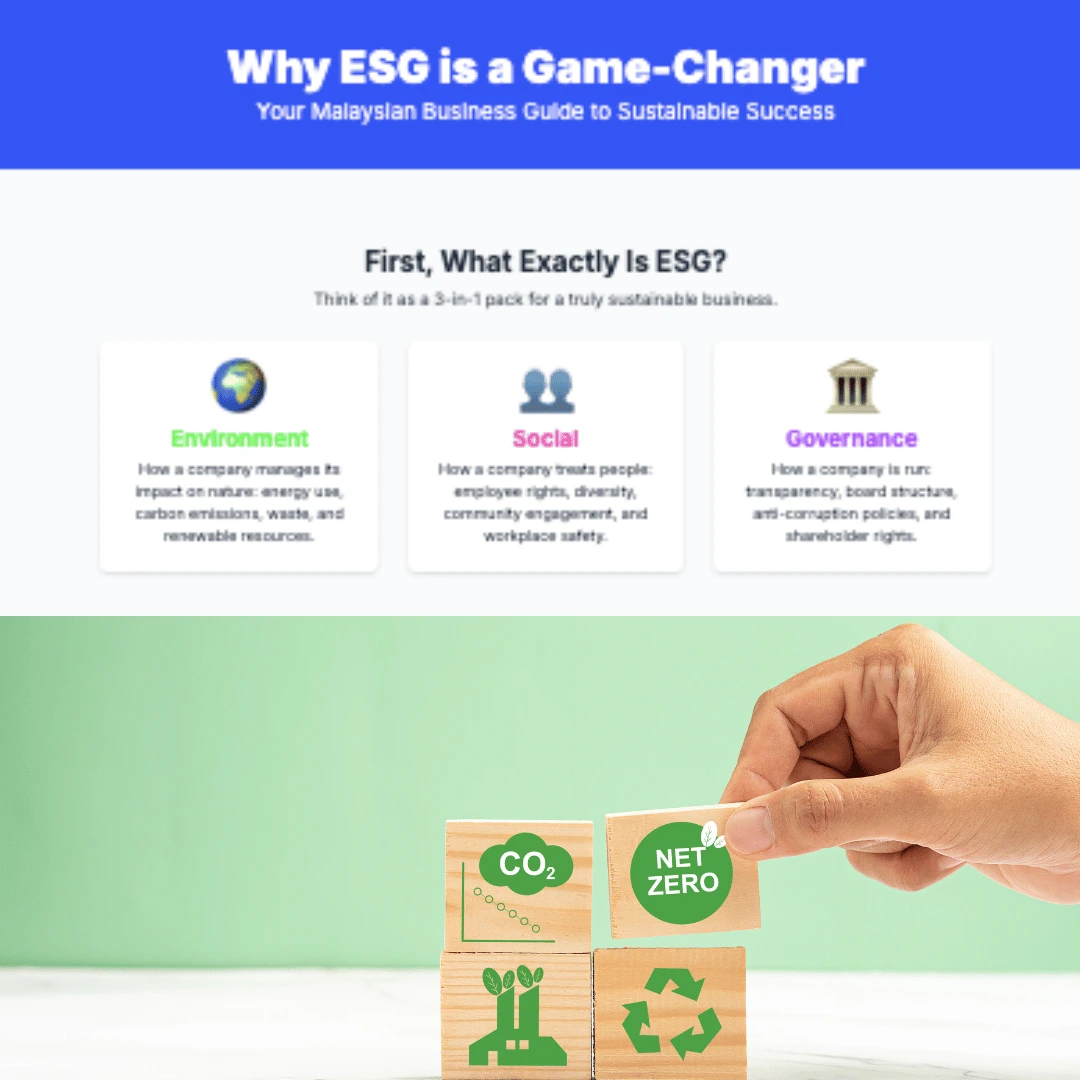
🤔 First Things First: What Is ESG?
Let’s make sure we’re on the same page.
E = Environment 🌍
How a company manages its impact on nature — energy use, carbon emissions, waste, water, renewable energy.
S = Social 👥
How a company treats people — employees, suppliers, communities. Issues like labour rights, diversity, safety, fair wages.
G = Governance 🏛️
How a company is run — transparency, board structure, anti-corruption, whistleblowing policies.
In short, ESG is like a 3-in-1 kopi-O packet: all three must be present for a business to be truly sustainable.
📌 Why ESG Is Important — The Big Picture
Here’s the main question: why is ESG important? Let me give you five big reasons, especially in the Malaysian context.
1. Because Regulations Are Tightening
- Bursa Malaysia already requires public listed companies (PLCs) to submit sustainability disclosures.
- From 2023 onwards, even SMEs supplying to PLCs are being asked for ESG data through the Simplified ESG Disclosure Guide (SEDG).
- The government rolled out the i-ESG Framework in 2023, guiding industries toward greener practices.
👉 So ESG is not “optional homework” anymore. It’s becoming mandatory, step by step.
2. Because Money Follows ESG
Here’s the part business owners really care about: financing.
- Banks like Maybank, CIMB, and RHB are rolling out green loans and ESG-linked financing. If you show strong ESG, you might enjoy better interest rates.
- Investors are more willing to pour money into ESG-compliant companies. Globally, ESG funds are booming, and Malaysia is catching up.
- Even EPF (our retirement fund) is aligning investments with ESG standards.
👉 Why this is important? Because without it, you might find it harder to get funding.
3. Because Customers Are Getting Smarter
Malaysians, especially Gen Z and millennials, are choosing brands that align with their values.
- Would you rather buy from a company that’s transparent and fair, or one that’s polluting rivers?
- Consumers now pay attention to sustainable packaging, fair trade products, and even carbon footprints.
Example: Nestlé Malaysia switching to paper straws in Milo packs — small move, big branding value.
👉 ESG matters because customers vote with their wallets.
4. Because Reputation Can Make or Break You
Let’s not forget the Top Glove incident.
- In 2020, the US banned imports from Top Glove over forced labour issues.
- Billions in market value were wiped out.
- It took them years of rectification before regaining access.
That’s the “S” in ESG. It shows that ignoring ESG isn’t just about bad PR — it can destroy your business overnight.
5. Because It Saves Costs and Improves Efficiency
ESG isn’t just about compliance. It’s also about running smarter.
- Energy efficiency = lower TNB bills.
- Waste reduction = less disposal cost.
- Safer workplace = fewer accidents, lower insurance payouts.
Malaysian SMEs that invest in solar rooftops, for example, see savings while also improving ESG credentials.
👉 So ESG is so important because it can directly improve your bottom line.
🧭 Why ESG Is Getting Important for Different Stakeholders
Okay, now let’s break it down by groups — because ESG doesn’t affect everyone the same way.

For Businesses
- Access to contracts (PLCs will only deal with ESG-compliant suppliers).
- Cheaper financing.
- Better reputation and competitiveness.
For Investors
- ESG companies = lower long-term risk.
- Higher valuations (FTSE4Good Bursa Index companies tend to trade at a premium).
- Avoid scandals that can crash stock prices.
For Employees
- Safer workplaces.
- More inclusive and fair company culture.
- Attracting younger talent who want meaningful jobs.
For Government
- ESG compliance helps Malaysia hit net-zero carbon goals by 2050.
- Builds resilience against climate change (floods, pollution, food security issues).
For Consumers
- More sustainable products.
- More transparent supply chains.
- Brands that reflect their values.
📊 Malaysian Examples: ESG in Action
Let’s look at some local cases where ESG plays a real role.
- Sime Darby Plantation
- Faced US import bans over forced labour (S).
- After corrective measures, they regained market access.
- Lesson: ESG is so important to stay in global supply chains.
- Faced US import bans over forced labour (S).
- Petronas
- Launched Net Zero Carbon Emissions 2050 roadmap (E).
- Heavy investment into renewable energy and carbon capture.
- Lesson: even oil & gas giants must go green.
- Launched Net Zero Carbon Emissions 2050 roadmap (E).
- Small SMEs
- Many SMEs now use the SEDG Malaysia template to disclose basic ESG data (like energy use, waste, anti-corruption policy).
- This makes them eligible suppliers for bigger PLC contracts.
- Many SMEs now use the SEDG Malaysia template to disclose basic ESG data (like energy use, waste, anti-corruption policy).
🛠️ How Malaysian Businesses Can Start With ESG
Now that we’ve answered it,let’s look at the practical: how to start.
- Understand Your Industry Risks
- Manufacturers → emissions, waste.
- Retail → supply chain ethics, packaging.
- Services → governance, labour practices.
- Manufacturers → emissions, waste.
- Start Small With Data Tracking
- Collect electricity and water bills.
- Track waste generated.
- Monitor employee training hours.
- Collect electricity and water bills.
- Adopt the SEDG Malaysia Guide
- Simplified ESG Disclosure Guide helps SMEs align with PLC expectations.
- Simplified ESG Disclosure Guide helps SMEs align with PLC expectations.
- Draft Simple Policies
- Anti-corruption.
- Health & safety.
- Whistleblowing.
- Anti-corruption.
- Communicate ESG Wins
- Put them in tender documents.
- Share them on your website and social media.
- Put them in tender documents.
🚀 The Future of ESG in Malaysia
Looking ahead, ESG will only become more important.
- Carbon tax is set to roll out by 2026 for certain sectors.
- Carbon markets (via Bursa Carbon Exchange) are already live.
- Global supply chains will increasingly demand ESG compliance.
- Consumers will demand transparency and sustainable products.
👉 Bottom line: if you’re not doing ESG, you’ll be left behind.

✅ Conclusion: Why ESG Is So Important in Malaysia
So, why is ESG so important? Because it’s no longer about “good to have”. It’s about survival and growth.
- Because regulators demand it.
- Because banks and investors reward it.
- Because customers and employees expect it.
- Because it protects your business from scandals.
- Because it saves costs and boosts efficiency.
Whether you’re a PLC, SME, or even an individual investor, ESG is shaping the future of Malaysia’s economy.
The question is no longer “why ESG is important?” The real question is: “Are you ready to adapt?”
Call-to-Action
💬 Want to start ESG but not sure how? Begin with small steps — track your energy, draft simple policies, and use the SEDG Malaysia guide. Don’t wait until you’re forced. Make ESG your business advantage today.