
Top ESG Reporting Standards Malaysia (2026 Guide)
Many Malaysian companies — especially SMEs and mid-sized corporates — struggle to understand which ESG reporting standards Malaysia they should follow. With increasing pressure from regulators, PLC buyers, investors and global supply chains, ESG reporting is no longer optional. But the problem is this: there are many ESG frameworks globally, and most companies aren’t sure which ones Malaysia actually uses.
This article explains, in simple Malaysian English, the top ESG reporting standards followed by Malaysian corporations, why these standards matter now, and what companies need to know to stay compliant, competitive, and tender-ready.
- Top ESG Reporting Standards Malaysia (2026 Guide)
- What is an ESG reporting standard?
- Why This Topic Matters Now?
- Top ESG Reporting Standards Used in Malaysia
- 1. Bursa Malaysia SEDG (Mandatory for PLCs)
- 2. ISSB Standards (IFRS S1 & IFRS S2)
- 3. GRI (Global Reporting Initiative)
- 4. TCFD (Task Force on Climate-related Financial Disclosures)
- 5. SASB (Sustainability Accounting Standards Board)
- 6. UN SDGs (United Nations Sustainable Development Goals)
- 7. CDP (Carbon Disclosure Project)
- Mistakes Malaysian Companies Make When Selecting ESG Standards
- Actionable Solutions (What Malaysian Companies Should Do Today)
- ESG reporting is now a core requirement
- Grab your checklist templates
What is an ESG reporting standard?
It is a recognised framework that guides companies on what to measure, what to report, how to report, and how to communicate their ESG performance.
Malaysian corporations — especially listed companies — follow ESG reporting standards that are:
- required by Bursa Malaysia
- recognised by global investors
- accepted in international supply chains
- aligned with government sustainability direction
These standards ensure companies report ESG in a way that buyers, investors and regulators can trust.
Why This Topic Matters Now?
In the last 3 years, Malaysia has seen major shifts:
- Bursa Malaysia introduced the SEDG (Sustainability Reporting Guide).
- Many banks now evaluate SMEs using ESG risk scoring.
- Global buyers require suppliers to meet minimum ESG disclosure standards.
- Investors want sustainability data before approving funding.
- Manufacturers must comply to avoid tender rejection.
Because of this, companies in manufacturing, property, energy, logistics, ICT, and retail now need to adopt internationally recognised ESG reporting standards.
Top ESG Reporting Standards Used in Malaysia
Below are the most widely used ESG reporting standards by Malaysian corporations, with clear explanations and local examples.
1. Bursa Malaysia SEDG (Mandatory for PLCs)
What is it?
Malaysia’s official sustainability reporting guideline for listed companies.
Why companies follow it:
- Required by Bursa Malaysia
- Sets the minimum ESG reporting expectations
- Includes materiality, governance, Scope 1–3 emissions, social practices, and governance structures
Used by:
- All PLCs
- Their Tier 1 and Tier 2 suppliers (indirectly)
2. ISSB Standards (IFRS S1 & IFRS S2)
What is ISSB?
Global sustainability standards that unify ESG reporting worldwide.
Why it’s important in Malaysia:
- Bank Negara and regulators support adoption
- Many corporates are transitioning to ISSB for global alignment
- Investors prefer ISSB because it standardises sustainability disclosures
Used by:
Banks, telcos, conglomerates, large manufacturers, energy players.
3. GRI (Global Reporting Initiative)
What is GRI?
The most widely used sustainability reporting framework globally.
Why Malaysian companies use GRI:
- Provides detailed KPIs
- Accepted by international buyers
- Strong for social & environmental reporting
- SMEs can use simplified GRI modules
Used by:
Property firms, manufacturers, plantations, logistics companies.
4. TCFD (Task Force on Climate-related Financial Disclosures)
What is TCFD?
A reporting standard focused on climate risks and opportunities.
Why Malaysian corporates follow TCFD:
- Banks require climate disclosures
- Bursa encourages climate-related risk reporting
- Part of transition to ISSB S2
Used by:
Banks, insurers, energy companies, transport companies.
5. SASB (Sustainability Accounting Standards Board)
What is SASB?
Industry-specific standards linked to financial performance.
Why Malaysian companies use SASB:
- Strong in corporate reporting
- Good for investor relations
- Helps link ESG to profit and risk
Used by:
Financial institutions, healthcare groups, tech companies.
6. UN SDGs (United Nations Sustainable Development Goals)
What is SDG reporting?
A global 17-goal framework linking ESG actions to global sustainability priorities.
Why Malaysian companies use SDGs:
- Easy to communicate
- Good for branding
- Recognised globally
- Often used alongside GRI or SEDG
Used by:
All sectors, especially retail, education, tourism, NGOs.
7. CDP (Carbon Disclosure Project)
What is CDP?
A global platform for reporting greenhouse gas emissions and climate risk.
Why Malaysian companies use CDP:
- Required by multinational buyers
- Used by supply chains linked to EU/US companies
- Strong carbon disclosure credibility
Used by:
Manufacturers, plantations, electronics, logistics.
Mistakes Malaysian Companies Make When Selecting ESG Standards
- Choosing too many frameworks at once
→ leads to confusion and inconsistent reporting. - Not aligning with Bursa SEDG
→ PLCs MUST follow SEDG; ignoring it creates compliance gaps. - Thinking ESG reporting = CSR
→ ESG is structured, measurable, audit-ready; CSR is not. - No internal ESG data collection system
→ makes reporting incomplete or inaccurate. - Copy-pasting foreign ESG reports
→ Malaysia has different regulations and expectations. - Focusing only on “Environmental” and ignoring Governance
→ Governance is heavily scrutinised by buyers and banks. - Not preparing suppliers
→ ESG must include the supply chain, not just internal reporting.

Actionable Solutions (What Malaysian Companies Should Do Today)
Here are practical steps companies can take NOW.
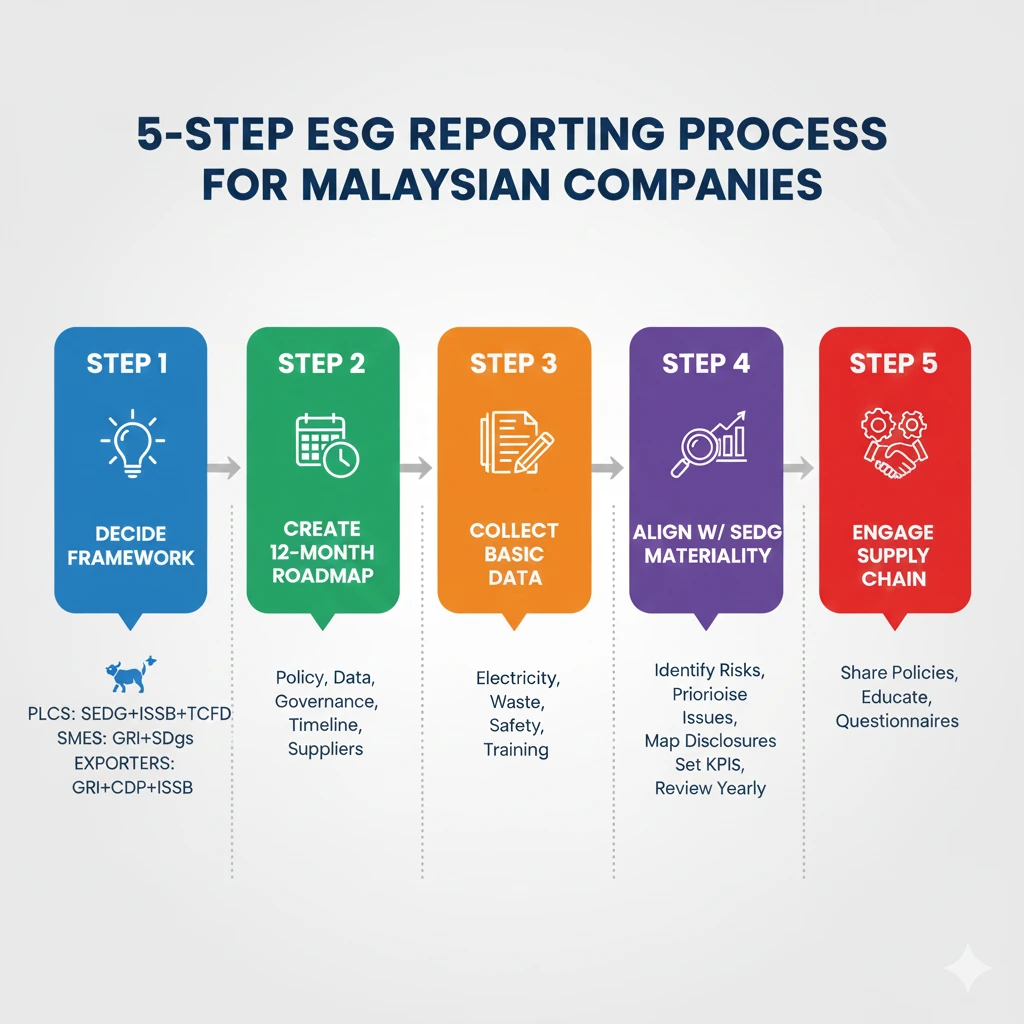
Step 1: Decide Your Primary ESG Framework
For most Malaysian companies:
- PLCs → SEDG + ISSB + TCFD
- Large SMEs → GRI + SDGs
- Export-focused → GRI + CDP + ISSB
- Local-only → SEDG simplified version
Step 2: Create a 12-Month ESG Reporting Roadmap
Include:
- policy development
- data collection
- governance practices
- reporting timeline
- supplier engagement
Step 3: Start Collecting Basic ESG Data
Examples:
- electricity bills
- waste disposal records
- worker safety logs
- training records
This forms the backbone of your ESG report.
Step 4: Align with Bursa Malaysia’s SEDG Materiality Process
Simple steps:
- Identify risks
- Prioritise material issues
- Map disclosures
- Set KPIs
- Review yearly
Step 5: Engage Your Supply Chain Early
For manufacturers:
- Ask suppliers to share simple ESG policies
- Educate them on documentation
- Use supplier self-assessment questionnaires
ESG reporting is now a core requirement
In Malaysia, ESG reporting is now a core requirement — not only for PLCs but for any company working with banks, multinationals, or global supply chains. By understanding the main ESG reporting standards such as SEDG, ISSB, GRI, TCFD, SASB, SDGs and CDP, companies can choose the right framework, avoid confusion, and build a stronger sustainability foundation.
The good news is that even SMEs can start with small steps: select one main framework, set up basic data collection, and align with Bursa Malaysia’s expectations. With a structured approach, any Malaysian company can become ESG-ready and stay competitive.
Grab your checklist templates
If you need simple templates, checklists or guidance to start ESG reporting for your company, you can always reach out for support. Many Malaysian businesses are taking their first ESG steps — you don’t have to do it alone.